DFT 密度泛函理论:从薛定谔方程到万物计算 | Density Functional Theory: From Schrödinger Equation to Computing Everything
什么是 DFT? 一种用量子力学计算多体系统电子结构的方法,21 世纪计算化学和材料科学的基石。 What is DFT? A quantum mechanical method for computing electronic structure of many-body systems — the workhorse of 21st century computational chemistry and materials science.
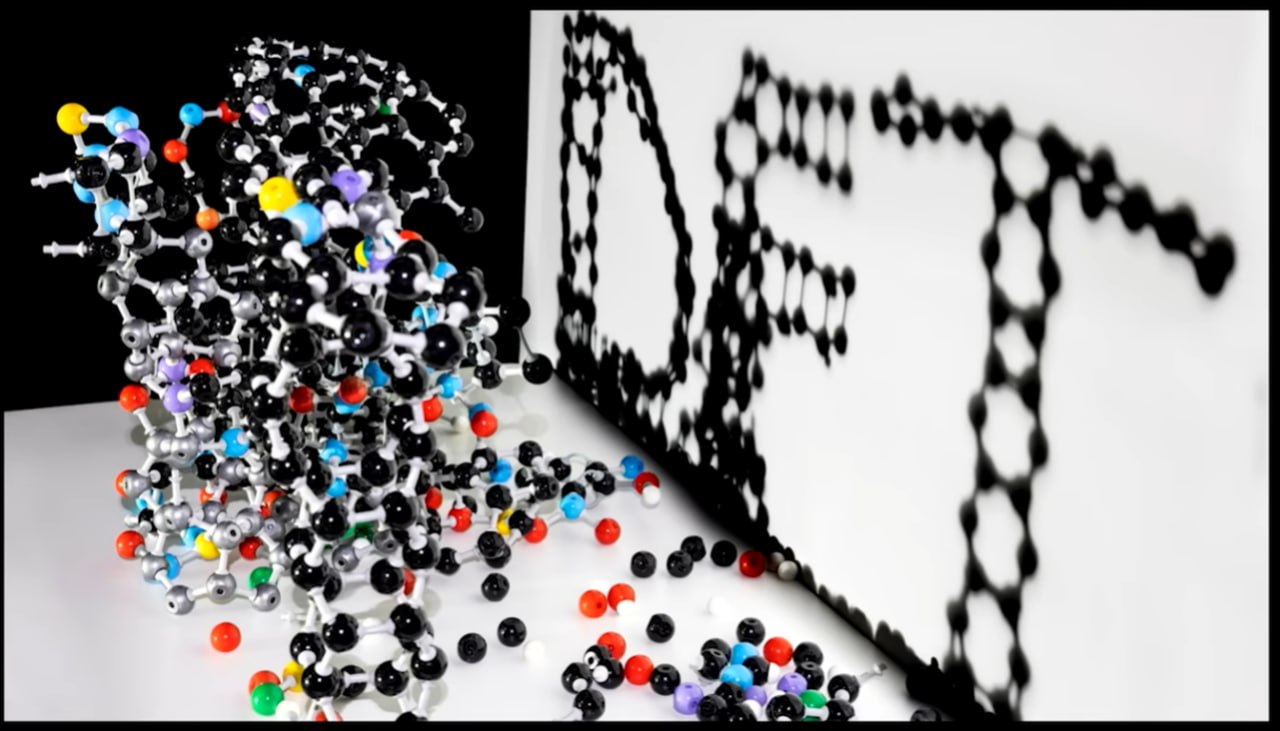 复杂分子模型的投影恰好是 "DFT" — 密度泛函理论就是隐藏在分子复杂性背后的数学秩序
Complex molecular model casting "DFT" as its shadow — the mathematical order hidden behind molecular complexity
复杂分子模型的投影恰好是 "DFT" — 密度泛函理论就是隐藏在分子复杂性背后的数学秩序
Complex molecular model casting "DFT" as its shadow — the mathematical order hidden behind molecular complexity
一个问题:薛定谔方程解不了 | One Problem: The Schrödinger Equation Is Unsolvable
1926 年,薛定谔写下了描述微观世界的方程:
$$\hat{H}\Psi = E\Psi$$
一个氢原子?能解。两个电子的氦原子?已经很难了。一个有几百个电子的分子?直接放弃吧。
In 1926, Schrödinger wrote down the equation that governs the microscopic world:
$$\hat{H}\Psi = E\Psi$$
One hydrogen atom? Solvable. A helium atom with two electrons? Already hard. A molecule with hundreds of electrons? Forget it.
问题出在哪里?波函数 Ψ 不是关于一个变量的函数,而是关于 所有电子位置 的函数。N 个电子,就有 3N 个空间变量。100 个电子 = 300 维的函数。这不是难算,是从根本上没法存、没法算。
The problem? The wavefunction Ψ isn't a function of one variable — it's a function of all electron positions simultaneously. N electrons means 3N spatial variables. 100 electrons = a function in 300 dimensions. This isn't hard to compute — it's fundamentally impossible to store or compute.
一个疯狂的想法 | A Crazy Idea
如果描述一个系统不需要波函数呢?
What if you don't need the wavefunction to describe a system?
1926 年,托马斯和费米提出了一个近似:用 电子密度 n(r) 代替波函数。电子密度只依赖三个空间坐标 (x, y, z),不管系统有多少个电子。
In 1926, Thomas and Fermi proposed an approximation: replace the wavefunction with electron density n(r). Electron density depends on only three spatial coordinates (x, y, z), regardless of how many electrons the system has.
这个想法很粗糙,但方向是对的。
The idea was crude, but the direction was right.
两个定理,改变一切 | Two Theorems That Changed Everything
1964 年,皮埃尔·霍恩伯格和沃尔特·科恩发表了一篇仅一页半的论文,奠定了 DFT 的理论基础。
In 1964, Pierre Hohenberg and Walter Kohn published a paper just one and a half pages long that laid the theoretical foundation for DFT.
第一定理:密度决定一切 | Theorem 1: Density Determines Everything
基态的所有性质都由电子密度唯一确定。知道密度,就知道一切。
All ground-state properties of a system are uniquely determined by its electron density. Know the density, and you know everything.
这意味着:多体问题的 3N 个变量,可以压缩到 3 个变量。
The many-body problem's 3N variables can be compressed down to 3.
第二定理:变分原理 | Theorem 2: Variational Principle
存在一个能量泛函 E[n],真实基态密度使这个泛函取最小值。
There exists an energy functional E[n], and the true ground-state density minimizes this functional.
这给出了求解方法:猜一个密度 → 算能量 → 调整密度 → 再算 → 直到能量最低。
This gives you a recipe: guess a density → compute energy → adjust density → repeat → until energy is minimized.
Kohn-Sham 方程:把不可能变成可能 | Kohn-Sham Equations: Making the Impossible Possible
霍恩伯格-科恩定理证明了密度足够描述一切,但没说怎么算。特别是动能泛函 —— 没人知道它的精确形式。
The Hohenberg-Kohn theorems proved that density is sufficient to describe everything, but didn't say how to compute it. Especially the kinetic energy functional — nobody knew its exact form.
1965 年,科恩和沈吕清提出了一个天才的技巧:
In 1965, Kohn and Lu Jeu Sham came up with a brilliant trick:
构造一个 虚拟的非相互作用系统,让它产生和真实系统完全相同的电子密度。这个虚拟系统的动能是已知精确形式的。真实系统和虚拟系统之间的差异,全部打包进一个叫"交换关联泛函"(exchange-correlation functional)的项里。
Construct a fictitious non-interacting system that produces exactly the same electron density as the real system. The kinetic energy of this fictitious system is known exactly. All the differences between the real and fictitious systems get packed into one term called the "exchange-correlation functional."
于是,复杂的多体薛定谔方程变成了 Kohn-Sham 方程 —— 一组单电子方程,可以迭代求解:
So the complicated many-body Schrödinger equation becomes the Kohn-Sham equations — a set of single-electron equations that can be solved iteratively:
$$\left[-\frac{\hbar^2}{2m}\nabla^2 + V_{\text{eff}}(\mathbf{r})\right]\psi_i(\mathbf{r}) = \varepsilon_i\psi_i(\mathbf{r})$$
其中有效势 $V_{\text{eff}}$ 包含外势、库仑排斥和交换关联作用。
Where the effective potential $V_{\text{eff}}$ includes the external potential, Coulomb repulsion, and exchange-correlation effects.
交换关联泛函:已知的未知 | The Exchange-Correlation Functional: The Known Unknown
DFT 在理论上是精确的 —— 如果你知道精确的交换关联泛函。但没人知道它长什么样。
DFT is exact in principle — if you know the exact exchange-correlation functional. Nobody does.
于是物理学家们做了一个实用主义的妥协:近似它。
So physicists made a pragmatic compromise: approximate it.
LDA(局域密度近似) — 最简单的近似。假设每一点的交换关联能等于均匀电子气在该密度下的值。效果出乎意料地好,尤其对固体。
LDA (Local Density Approximation) — the simplest approximation. Assume the exchange-correlation energy at each point equals that of a uniform electron gas at that density. Works surprisingly well, especially for solids.
GGA(广义梯度近似) — 加入密度的梯度信息。PBE 泛函是最常用的 GGA 之一。
GGA (Generalized Gradient Approximation) — adds density gradient information. The PBE functional is one of the most widely used GGAs.
杂化泛函 — 混入一部分精确的 Hartree-Fock 交换能。B3LYP 是化学界的明星泛函。
Hybrid functionals — mix in some exact Hartree-Fock exchange. B3LYP is the star functional in chemistry.
这个"已知的未知"是 DFT 的核心矛盾:理论上是精确的,实践上必须近似。但近似得足够好,已经改变了科学的面貌。
This "known unknown" is the core tension of DFT: exact in theory, approximate in practice. But the approximations are good enough to have transformed science.
DFT 的历史年表 | A Brief Timeline
| 年份 | 事件 |
|---|---|
| 1927 | Thomas-Fermi 模型 — 用密度代替波函数 |
| 1951 | Slater 的 Xα 方法 — DFT 思想的前奏 |
| 1964 | Hohenberg-Kohn 定理 — 理论基础确立 |
| 1965 | Kohn-Sham 方程 — 实用计算方法 |
| 1972 | Janak 将 KS 方程扩展到分数占据数 |
| 1980 | PBE 等 GGA 泛函开始出现 |
| 1988 | BLYP 泛函 — 化学计算的突破 |
| 1993 | B3LYP 杂化泛函 — 成为量子化学标准工具 |
| 1998 | Walter Kohn 获诺贝尔化学奖 |
| 2000s | 色散修正、meta-GGA、双杂化等新泛函爆发 |
| 2020s | 机器学习辅助泛函开发,精度逼近实验 |
应用:DFT 算些什么? | Applications: What Does DFT Compute?
DFT 是目前应用最广泛的量子力学计算方法。以下是它的主战场:
DFT is the most widely used quantum mechanical computational method. Here are its main battlefields:
材料设计 | Materials Design
计算新材料的电子结构、能带、晶格常数,在合成之前预测其性质。半导体、电池材料、催化剂 —— DFT 是材料发现的"第一筛"。
Compute electronic structure, band gaps, and lattice constants of new materials before synthesis. Semiconductors, battery materials, catalysts — DFT is the "first filter" for materials discovery.
化学反应机理 | Chemical Reaction Mechanisms
计算反应路径、过渡态能量、活化能。工业催化过程(包括光刻胶中的聚合反应)的设计和优化离不开 DFT。
Compute reaction paths, transition state energies, and activation energies. Industrial catalytic processes — including polymerization reactions in photoresists — cannot be designed and optimized without DFT.
药物设计 | Drug Design
计算分子间相互作用、蛋白质-配体结合能。虽然对大生物分子有局限,但小分子药物筛选仍然大量使用 DFT。
Compute intermolecular interactions and protein-ligand binding energies. Despite limitations for large biomolecules, small-molecule drug screening relies heavily on DFT.
半导体物理 | Semiconductor Physics
能带结构、缺陷能级、掺杂效应 —— 所有半导体器件设计的量子力学基础。
Band structures, defect levels, doping effects — the quantum mechanical foundation of all semiconductor device design.
表面与催化 | Surface Science & Catalysis
吸附能、表面重构、催化活性位点。DFT 是理解金属和氧化物表面化学反应的主要工具。
Adsorption energies, surface reconstructions, catalytic active sites. DFT is the primary tool for understanding chemical reactions on metal and oxide surfaces.
为什么 DFT 如此重要? | Why Is DFT So Important?
一句话:它把 3N 维的问题压缩到 3 维,同时保留了足够的精度。
In one sentence: It compresses a 3N-dimensional problem to 3 dimensions while retaining enough accuracy.
更具体地说:
More specifically:
1. 复杂度革命 — Hartree-Fock 方法随 N⁴ 增长,精确后 Hartree-Fock(CCSD(T))随 N⁷ 增长。DFT 大约 N³。对 100 个原子的系统,差距是天壤之别。
Complexity revolution — Hartree-Fock scales as N⁴, coupled-cluster CCSD(T) as N⁷. DFT scales roughly as N³. For a 100-atom system, the difference is night and day.
2. 精度够用 — 对大多数固体,DFT 给出的晶格常数误差小于 1%。键能误差在几个 kcal/mol 范围内。这对工程应用足够了。
Good enough accuracy — For most solids, DFT gives lattice constants within 1% of experiment. Bond energies within a few kcal/mol. That's sufficient for engineering.
3. 普适性 — 从单原子分子到上万原子的纳米结构,从绝缘体到金属,从基态到激发态(TDDFT)。一套方法覆盖整个物质世界。
Universality — From single atoms to nanostructures with tens of thousands of atoms, from insulators to metals, from ground states to excited states (TDDFT). One method covers the entire material world.
4. 诺贝尔奖认证 — 1998 年,Walter Kohn 因 DFT 获得诺贝尔化学奖。一个理论物理学家拿了化学奖,说明这个方法跨越了学科边界。
Nobel-certified — Walter Kohn won the 1998 Nobel Prize in Chemistry for DFT. A theoretical physicist winning a chemistry prize tells you this method crossed disciplinary boundaries.
DFT 的局限 | Where DFT Falls Short
DFT 不是万能的。它的主要弱点:
DFT isn't a silver bullet. Its main weaknesses:
范德华力(色散) — 标准泛函描述不了长程弱相互作用,需要额外修正
强关联体系 — 过渡金属氧化物、高温超导等,DFT 经常失效
带隙低估 — 半导体带隙通常被低估 30-50%
激发态 — 需要 TDDFT,精度不如基态
泛函选择没有标准答案 — 不同泛函给出不同结果,选哪个取决于经验和体系
Van der Waals forces (dispersion) — standard functionals can't describe long-range weak interactions; corrections are needed
Strongly correlated systems — transition metal oxides, high-Tc superconductors; DFT often fails
Band gap underestimation — semiconductor band gaps typically underestimated by 30-50%
Excited states — need TDDFT, less accurate than ground-state
No universal functional — different functionals give different results; choice depends on experience and system
一个类比 | An Analogy
想象你要描述一个城市的交通状况。
Imagine you want to describe the traffic in a city.
薛定谔方程方法: 追踪每一辆车的位置、速度、驾驶员的心情、每辆车的引擎状态。精确,但不可能。
Schrödinger equation approach: Track every car's position, speed, driver's mood, engine status. Exact, but impossible.
DFT 方法: 看地图上的车流密度分布。哪条路堵、哪条路空,一目了然。损失了单辆车的细节,但抓住了整体模式。
DFT approach: Look at the traffic density map. Where it's congested, where it's clear. You lose individual car details, but capture the overall pattern.
电子密度就是城市的车流密度。知道它,你就能算出绝大多数你关心的东西。
Electron density is the city's traffic density. Know it, and you can compute almost everything you care about.
总结 | Summary
DFT 是 20 世纪理论物理学最成功的"降级"之一:
DFT is one of the most successful "downgrades" in 20th century theoretical physics:
放弃 精确的波函数(3N 维)
拥抱 电子密度(3 维)
打包 所有不知道的东西到一个泛函里
近似 那个泛函,近似得足够好
Abandon the exact wavefunction (3N dimensions)
Embrace electron density (3 dimensions)
Pack everything unknown into one functional
Approximate that functional, well enough
它不完美,但它能用。而在科学和工程中,"能用且够用"往往比"完美但算不了"重要得多。
It's not perfect, but it works. And in science and engineering, "works well enough" is often much more important than "perfect but impossible to compute."
Posted: 2026-05-29
延伸阅读 | Further Reading:
- Rev. Mod. Phys. 87, 897 (2015) — "Density functional theory: Its origins, rise to prominence, and future"
- Hohenberg & Kohn, Phys. Rev. 136, B864 (1964) — 原始论文
- Kohn & Sham, Phys. Rev. 140, A1133 (1965) — KS 方程
- Wikipedia: Density functional theory — 全面综述
Comments (0)
Login to leave a comment.